
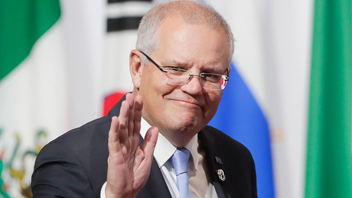
Since their initial discovery, Marsh and Elfenbein have detected more of these “non-verbal accents” – physical ways in which we show where we come from without realizing. Americans, for example, can spot Australians from the way they smile, wave or walk.
Scott Morrison. Prime Minister of Australia.
Australians have a distinctive wave that Americans in one study were able to correctly identify (Credit: Alamy)
More recent research supports their findings. A team at the University of Glasgow has now trained a computer to recognize and then generate more than 60 different non-verbal accents on a simulated face. Subtle, almost indecipherable differences in the way a nose wrinkles and a lip is raised were often all that differentiated them. But when East Asians were shown these artificial “East Asian” expressions, they recognized them much more easily than “Western” ones. “It’s harder than it sounds,” says Rachael Jack, whose lab conducted the research. Before they could even begin, for instance, Jack and her team had to establish which words in English and Chinese referred to roughly corresponding feelings.
The fact that non-verbal accents exist shouldn’t be that surprising. People recognize individual voices and faces, and even walking or running styles, without knowing exactly what makes them recognizable.
Kolor tła
Czcionka
Kerning czcionki
Rozmiar czcionki
Widoczność obrazu
Odstępy między literami
Wysokość linii
Wyróżnienie Linku
Szerokość akapitu
Wyrównanie tekstu
Kolor tekstu